GUIDES
Best Minimalist Leather Wallets 2026: Maker's Guide
Most "best minimalist wallet" lists are written by people who have never cut a hide or set a saddle stitch. This one is written from a workbench where we've built and repaired enough wallets to know exactly where they fail, what makes them last, and which style actually suits which pocket.
So here's the deal: we'll show you how to judge any minimalist wallet — ours, a competitor's, the one at the airport kiosk — and then give straight recommendations by carry style. Where a style isn't our lane, we'll say so.
What "minimalist" should actually mean
A minimalist wallet isn't just a small wallet. It's a wallet designed around what you actually carry in 2026 — which, for most people, is three to six cards, a folded bill or two, and nothing else. Tap-to-pay killed the receipt brick. The checklist that matters:
Thickness under ~12mm loaded. The whole point. If it prints through a front pocket like a deck of cards, it's a small bifold, not a minimalist wallet.
Full-grain leather, or don't bother. At minimalist sizes there's nowhere for cheap material to hide — every surface is visible and every edge gets handled daily. "Genuine leather" (the low grade, despite the name) delaminates and peels fastest exactly at this scale. Full-grain — the intact outer layer of the hide — is the only grade that gets better with daily carry. We've written a complete breakdown of the grades if you want the deep dive.
Stitching that outlives the leather's first decade. Look for saddle stitching at stress points: two needles, one thread, locked at every pass. If a machine lockstitch pops one loop, the seam can unzip; a saddle stitch holds even with a broken thread. It's slower and costs more to produce, which is why most brands skip it. It's also why a $27 hand-stitched wallet can outlast a $90 machine-made one.
Structure without bulk. Card slots should grip on day one and relax to your stack — not gape after a month. That's a function of leather tension and slot geometry, not padding.
Edges that are finished, not painted shut. Burnished or hand-finished edges wear gracefully. Thick paint-dipped edges crack and flake within a year — the most common cosmetic failure we see.
The four minimalist styles in 2026, compared
| Style | Loaded thickness | Capacity | Best for | Watch out for |
|---|---|---|---|---|
| Card holder | 6–10mm | 3–6 cards + folded bills | Tap-to-pay users, small bags, shirt pockets | Cash is a fold-and-tuck affair |
| Front pocket wallet | 9–12mm | 4–8 cards + bills | The "I still want a real wallet" minimalist | Cheap ones bulk up fast — check the leather layers |
| Cash clip wallet | 8–12mm | 3–5 cards + clipped bills | Cash-first carriers | Clip tension is the failure point — look for stitched, replaceable designs |
| Metal/hybrid (Ridge-style) | 6–12mm | 4–12 cards | Gadget-lovers, heavy RFID worriers | It'll look identical in year five — for better and worse. Not our lane; we're a leather shop and that's a taste question |
The honest guidance: if you tap to pay and rarely touch cash, get a card holder. If you want one object that does everything a wallet did but flat, get a front pocket wallet. If you're a cash person, the clip style earns its keep. We compare the first two in detail in front pocket vs bifold vs card holder.
Our picks by carry style (from the bench)
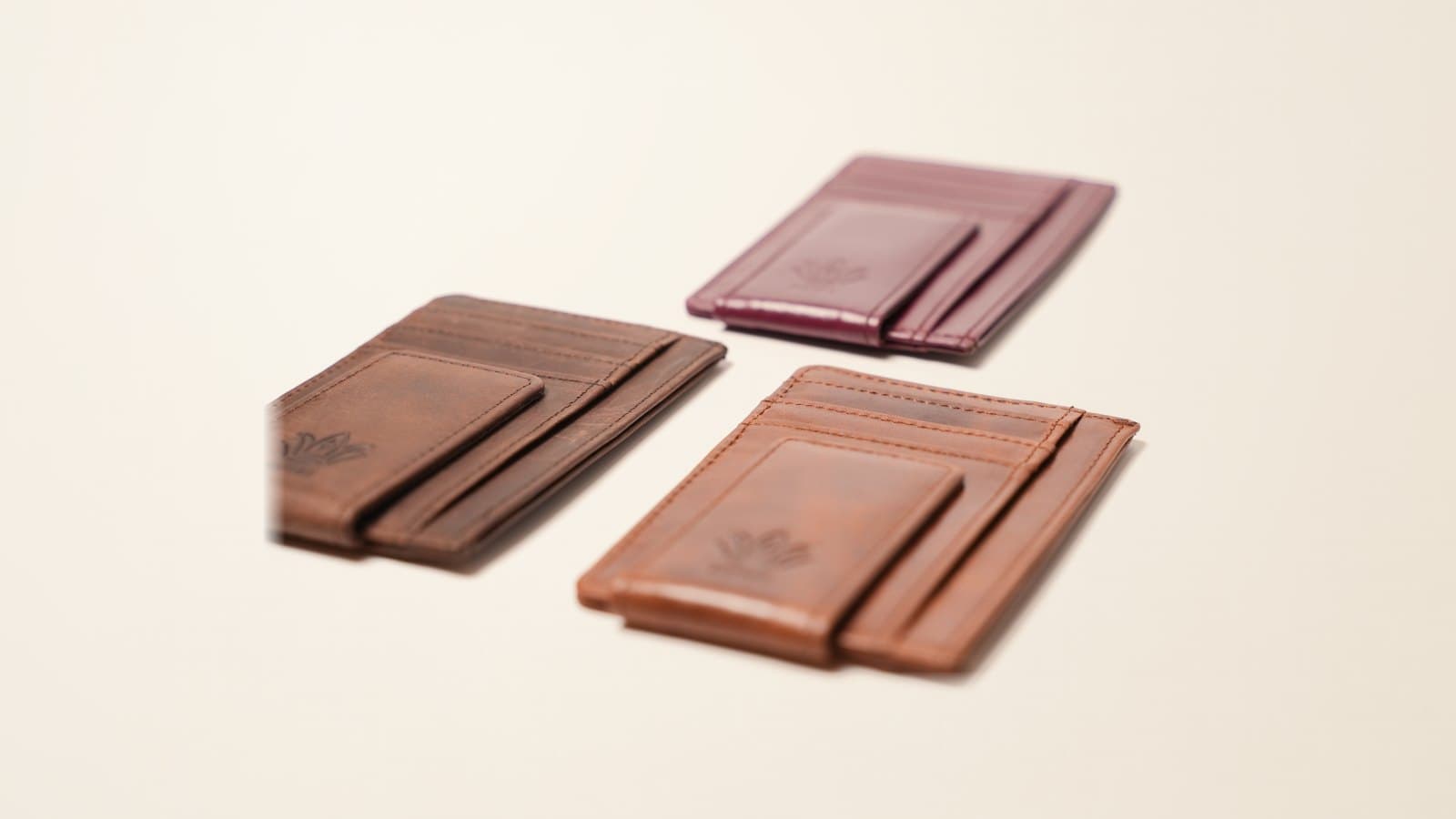
Best all-round minimalist: the hand-stitch front pocket wallet — from $26.99. This is the wallet we'd hand a friend who asked for "just the right answer." Full-grain leather, saddle-stitched at the corners where wallets die, 4–8 cards, flat enough for a front pocket, and it develops the kind of patina that makes people ask where you got it. In black or chocolate for the office; tan if you want the leather to tell on you. See the wallets →
Slimmest daily carry: the hand-made card holder — from $20. Three to five cards, a folded twenty behind them, six millimeters of full-grain and nothing else. This is the one that converts bifold lifers — it disappears into a shirt pocket or a small bag. The green and burgundy leathers are the sleeper picks here; minimalist doesn't have to mean beige. See the card holders →
Best for cash carriers: the cash clip wallet. Cards on one face, bills under tension on the other, no folding origami at the register. If your week involves markets, tips, or splitting checks in cash, this layout beats a card holder every time.
Best gift: any of the above. A minimalist wallet is the single most-gifted item we make — under $50, unisex sizing, and something they will carry every day.
If you want metal: that's genuinely fine — but it's a different product philosophy (fixed capacity, aluminum aesthetics, mechanical fidget factor), and we'd rather point you at that category honestly than pretend leather does what metal does. What metal never does is age into something that looks like it has a history.
The RFID question, answered honestly
Half the minimalist wallets on the market lead with RFID blocking. Here's the maker's view: modern contactless cards use encrypted, one-time transaction codes, and documented real-world skimming is vanishingly rare. RFID lining adds a layer of stiff material to a product whose entire job is to be thin and supple. We've laid out the evidence in RFID wallets explained — short version: if RFID blocking gives you peace of mind, it's harmless; if you're choosing between blocking and better leather, take the leather.
Break-in: what the first 90 days should look like
A quality minimalist wallet has a lifecycle, and knowing it helps you judge what you bought:
- Weeks 1–2: slots feel tight — correct. Full-grain relaxes to your exact card count without going slack.
- Months 1–3: the leather molds to your pocket's curve; color deepens slightly at handling points.
- Month 3+: first light conditioning — five minutes, twice a year, is the entire maintenance contract.
- Year 1+: fold lines darken, corners burnish, and the wallet becomes unmistakably yours. This is the part cheap wallets never reach — they crack before they character.
If a wallet goes floppy, gapes, or sheds its edge coating inside a year, it wasn't built for the long game — which is exactly what a warranty is for. (Ours is 1 year on stitching and hardware, with 30-day returns if the style isn't right.)
The math that makes minimalist make sense
A $15 department-store wallet lasts about two years before the lining shreds or the edges peel. A hand-stitched full-grain wallet at $27 lasts a decade with trivial care. That's roughly $75 versus $27 over ten years — the handmade option is the cheap one, it just pays upfront. Factor in that you handle a wallet several times a day, every day, and cost-per-use beats almost anything else you own.
Frequently asked questions
What is the best minimalist wallet style in 2026?
For most people: a card holder if you rarely carry cash, a front pocket wallet if you want full function in a flat profile. The deciding question is how often you handle bills — weekly or more means get a dedicated cash solution (front pocket wallet or cash clip).
How many cards should a minimalist wallet hold?
Audit your actual daily carry first — most people use 3–5 cards. Choose a wallet rated for that number, not for your theoretical maximum; oversized capacity defeats the slim profile and lets cards shift and wear.
Is full-grain leather worth it for a small wallet?
More than for any other leather good. Small pieces get handled constantly and have no hardware or lining to hide behind — material quality is the whole product. Full-grain resists cracking, develops patina instead of wear, and typically lasts 5× longer than "genuine leather."
Do minimalist wallets need RFID blocking?
It's optional. Contactless payment cards use encrypted one-time codes, and real-world skimming is rare. Choose RFID lining for peace of mind if you like — but never at the cost of leather quality or slimness.
Are handmade minimalist wallets worth the price?
When the price is $20–$45, the honest answer is that handmade is the value option: saddle stitching and full-grain leather at that price outlasts machine-made $90 alternatives. The "worth it" question really applies above the $100 line.
Every wallet in this guide is cut and saddle-stitched by hand — see the full collection, or start slimmer with a card holder.
Shop the story