LEATHER EDUCATION
RFID Wallets Explained: Do You Actually Need One?
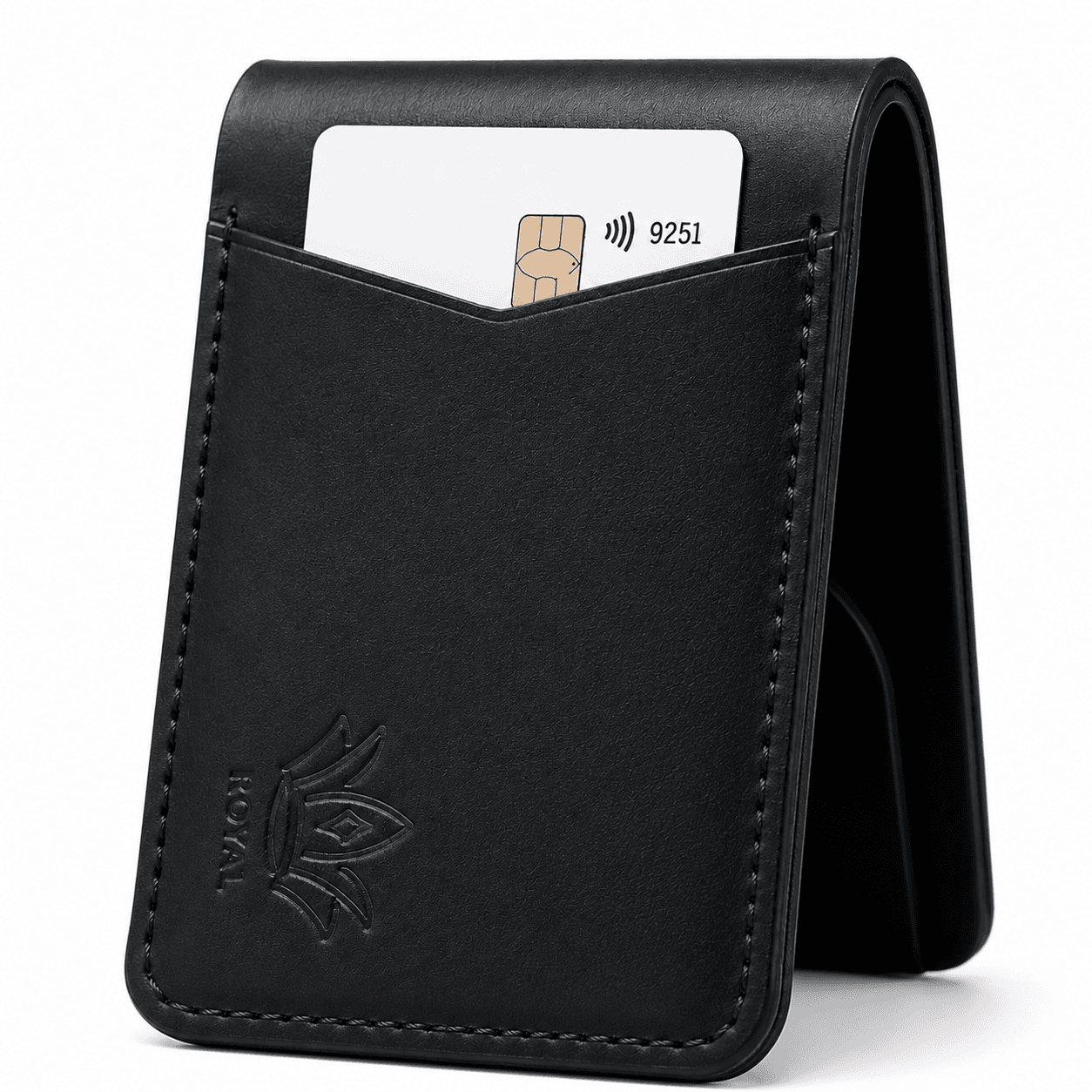
Walk into any luggage shop and half the wallets on the wall carry an "RFID blocking" badge. The pitch is simple and a little frightening: somebody with a reader in a backpack brushes past you on a train and walks off with your card. We make wallets for a living, and people ask us about this every week, so here is the straight answer — including the part where we tell you that none of our wallets has an RFID layer, and why.
Short version: for contactless bank cards, RFID blocking is a precaution rather than a necessity. Skimming them in everyday life is uncommon, and card issuers and networks add protections of their own. There are a few things in a wallet that are genuinely worth shielding, and a cheap sleeve does that job better than a lining sewn into a whole wallet. The rest of this article is the detail behind that.
What RFID actually is
RFID stands for radio-frequency identification: a tiny chip and an antenna that answer when a reader powers them with a radio field. There is no battery. The chip wakes up only while it sits inside a reader's field, says what it was built to say, and goes quiet again.
The tap-to-pay chip in a bank card is a short-range version of this, often called NFC. It is designed to be read at close range — that is why you bring the card up to the terminal to pay. Hotel key cards, transit cards, office badges and the chip in a passport book use the same family of technology, with very different levels of security.
What a skimmer can and cannot get from a bank card
This is the part the marketing skips. Modern contactless cards have security features of their own: for each payment the card generates a code meant for that transaction, which is designed to make captured details hard to reuse. That lowers the risk; it does not make any card impossible to misuse.
Depending on the card, a reader held very close to it might pick up some details, such as the card number and expiry date. Card issuers and networks add protections of their own, such as fraud monitoring and a way to dispute a charge you did not make; what applies depends on your card, so check your bank's terms.
Then there is the practical side. To read a card through a pocket, a thief has to get a reader very close to it, usually in a crowd. In everyday life, this kind of contactless skimming is uncommon. Card fraud is overwhelmingly done the easy way: data breaches, phishing, and tampered card readers at gas pumps and ATMs. An RFID wallet stops none of those.
What is genuinely worth shielding
We do not want to swing too far the other way, because some cards in a wallet are weaker than a bank card:
- Older office and building badges. Many access systems still use low-frequency proximity cards that broadcast a fixed number. Those can be copied by anyone who gets a reader close enough, and a copied badge opens the same door. If your badge is one of these, it is the card most worth a sleeve.
- Some hotel and transit cards carry simple chips. The stakes are usually low — a hotel key expires when you check out — but the protection is cheap if you want it.
- Passports. A US passport book has a thin shielding layer built into its cover, designed to stop it being read while it is closed. The wallet-sized US passport card has no such layer and comes with its own protective sleeve, which is worth keeping.
Notice the pattern: the cards that need shielding are specific ones, and each can be protected on its own.
Why none of our wallets has an RFID layer
We are asked this most about the slim pieces, so here is the workshop reasoning. An RFID-blocking wallet works by wrapping the cards in something conductive — a metallised fabric or a foil laminate between the layers of leather — so that the reader's field cannot reach the chip. That layer has consequences you can feel:
- It adds thickness and stiffness to a wallet whose whole job is to be thin and to soften to your cards.
- It changes how the leather breaks in. A laminated panel does not mould to a pocket the way plain leather does, and the fold of a bifold is exactly where it creases.
- It fails quietly. Foil laminates crack along the fold over time, and nothing tells you when the shielding stopped working.
- It blocks everything, always. You cannot tap one card and keep another shielded; the whole wallet is either open or closed to the reader.
So we build plain, saddle-stitched leather and do not add a layer we would not want ourselves. That is a choice, not an oversight, and our product pages say so: none of our leather wallets or card holders claims to block RFID.
If you want protection anyway, do it this way
Peace of mind is a perfectly good reason, and it does not have to cost you a stiff wallet. Three options, cheapest first:
- A shielding sleeve for the one card that matters. Put the office badge or the card you worry about in a thin sleeve and leave the rest free to tap. Sleeves are inexpensive, replaceable, and protect exactly what needs it.
- A blocking card in one slot. These are card-sized inserts sold to shield the cards either side of them. They vary in how well they work, so test yours (below) before you trust it.
- Turn off contactless. Many banks let you switch contactless off for a card in their app, or will issue a card without it. Pay with your phone instead: phone wallets use a stand-in card number and usually ask for your face, fingerprint or code before they pay.
How to test any of them in thirty seconds: put the card in the sleeve or behind the blocking card and hold it to a contactless terminal at checkout, or to your phone with an NFC reading app. If it reads, it is not shielded. The same test tells you whether a wallet sold as "RFID blocking" actually is.
What to look for in a wallet instead
If the badge is not the thing to judge a wallet by, what is? The same things that decide whether it is still in your pocket in five years: the leather, the stitching at the corners, and whether it is the right size for what you carry. We cover the leather grades in full-grain vs top-grain vs genuine leather, and the styles — card holder, front pocket wallet, bifold — in our guide to minimalist wallets. If you are weighing a handmade wallet against a factory one, are handmade leather wallets worth it? is the companion to this article.
Frequently asked questions
Do I need an RFID-blocking wallet?
For contactless bank cards, most people do not: RFID blocking is a precaution, not a necessity. Contactless skimming is uncommon in everyday life, cards are designed to be read at close range, and card issuers and networks add protections of their own. Shield a weak office badge or a passport card on its own if you want to.
Can someone steal my card details by walking past me?
In theory a reader held very close can pick up some card details; in everyday life it is uncommon, and card issuers and networks add protections of their own. Breaches, phishing and tampered card readers are far more common ways cards are stolen, and an RFID wallet stops none of them.
Do Royal wallets block RFID?
No. None of our wallets or card holders has an RFID layer, and none of our product pages claims one. A shielding layer would make them thicker and stiffer, so we leave it out and suggest a sleeve for any card you want shielded.
What should I do if I want RFID protection anyway?
Put the card you worry about in a thin shielding sleeve, or carry a blocking card in one slot, and test it at a contactless terminal before you rely on it. Many banks also let you switch contactless off in their app.
Does RFID blocking stop my phone's tap-to-pay?
A blocking wallet only shields the cards inside it. A phone wallet uses a stand-in card number and usually asks for your face, fingerprint or code before it pays, so a blocking layer adds little.
Does my passport need an RFID wallet?
A US passport book has a shielding layer in its cover, designed to stop it being read while closed. The wallet-sized passport card does not, and it comes with a protective sleeve; keep it in that sleeve.
Every Royal wallet is cut and saddle-stitched by hand, with 30-day returns and a 1-year warranty. Browse the wallets or the card holders.
Shop the story