GUIDES
Green Leather Wallets for Men
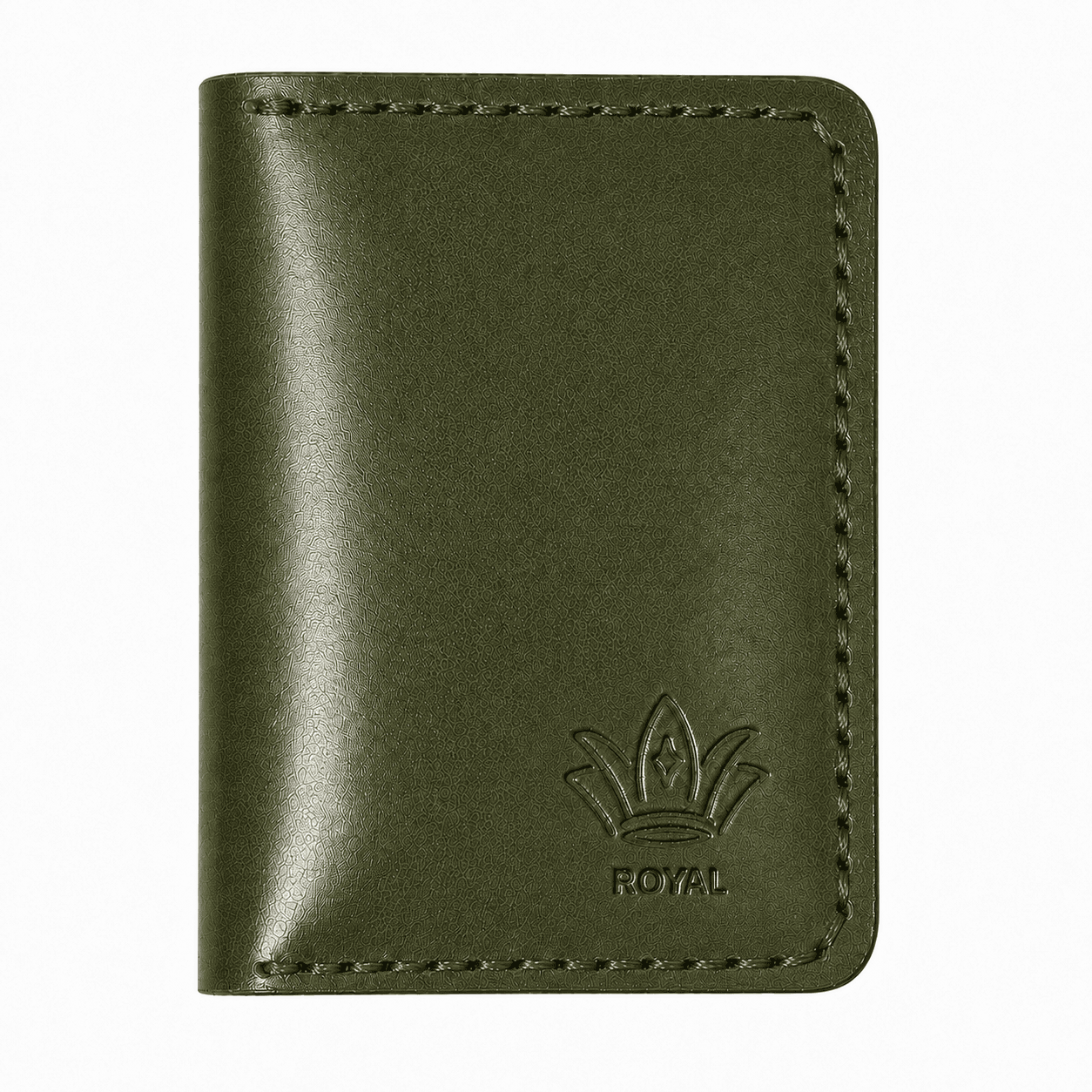
Most men's wallets are black or brown, and most of the time that is the right call. Green is the colour you choose when you already own the right call and want a wallet that is not the same as the one in every other pocket at the table. It is also, among the colours full-grain leather is dyed, the one that rewards the longest: a deep forest green does something over a year that black never will.
This is a guide to green leather specifically: how it ages, what it pairs with, how to tell a green that is dyed through from one that is painted on, and which formats it suits. It does not explain leather grades, wallet formats or who to buy for; those have their own posts and this one links to them where they are needed.
Why green, and why now
Green leather has moved from an eccentric choice to a settled one. The reason is partly that it sits between the two defaults. Black is formal and disappears; tan is casual and changes fast. A dark green reads as considered without being showy, works with a navy suit and with denim, and does not have to match a belt or a strap, which is the matching rule that keeps most men in brown.
The other reason is how it wears. On full-grain leather the colour is not a surface; it is in the fibres. Green is dyed from a mid-depth, so as the surface burnishes under your hands the folds and the corners lighten toward an olive, while the flat panels deepen toward bottle green. Within a year a green wallet carries a range of tones that a black wallet cannot show and a tan wallet moves through too quickly to keep.
How green full-grain ages
Three stages, in order, on a piece carried daily.
The first month
The colour is at its flattest and most uniform, a deep even green with a matte surface. This is also when the leather is stiffest; the fit is being set and the colour has not yet started to move. What to do and not do in these weeks is in how to break in a leather wallet, and none of it is particular to green.
Months two to six
A sheen builds where your thumb lands and where the fold creases. The sheen on green reads slightly bluer than the matte base, so the wallet starts to show depth: a glossy forest green at the high points, a softer olive where the leather compresses over the edge of a card. This is the stage people photograph.
The first year and after
The whole surface has burnished and the contrast has settled. Corners and the fold are a lighter, warmer olive; the panels are a dark glossy green that goes almost black in low light. Any scuff takes the colour with it rather than showing white, which is the difference between dyed-through leather and coated leather, and the reason a green wallet in full-grain is a better long-term buy than a green wallet in anything else. If you want the chemistry of why, the grades are set out in full-grain vs top-grain vs genuine leather.
Dyed through, or painted on: how to tell
Green is the colour where the difference between good and bad leather is easiest to see, because a cheap green is a pigment coat over a grey or tan base, and the base shows at the first scratch. Four checks, none of which need you to hold the piece:
- Look at a cut edge. A dyed-through hide is green through its thickness. A coated hide is green on top and grey or tan in the cross-section. Product photographs that show a burnished edge show this; photographs that never show an edge are usually avoiding it.
- Look for variation. Real dyed hide is not perfectly even. Across one panel there will be slightly deeper and slightly lighter green, following the grain. A perfectly flat, uniform green is a coat.
- Ask what the leather is. A maker using full-grain says so. A listing that says "green leather" and nothing more is describing the colour because the grade would not help the sale.
- Check how it is described as ageing. A dyed full-grain green is sold on its patina. A coated green is sold on "stays looking new", which is a promise that it has no depth to reveal.
What green goes with
The short answer is more than brown does. The long answer, by what is on the rest of you:
- Navy and grey tailoring. The best case for green. A dark green wallet drawn from a navy jacket looks deliberate in a way that a brown one does not and a black one cannot.
- Denim and casual wear. Green sits naturally with indigo and with the earth tones casual wardrobes run on. It is the one wallet colour that works equally with a black belt and a brown one.
- Black leather elsewhere. Green does not have to match a black watch strap or a black belt, and does not look wrong beside them. This is the matching rule that keeps most men in black, and green is exempt from it.
- Tan and natural leather. The one pairing to think about. A pale tan strap next to a dark green wallet can read as two unrelated colours. A burgundy or chocolate strap beside green reads as a set.
The formats green suits
Green shows its character at the folds and the edges, so it suits formats with more of those per square inch: a card holder shows more olive-at-the-corners per year than a bifold does, simply because the whole piece is corners and slot mouths. That is why the piece we make in green is the hand-made card holder in green: full-grain, hand-stitched, with the slots and the burnished edges where the colour moves most.
For a larger green wallet, the same rules apply as for any colour, and the choice between a card holder, a front pocket wallet and a bifold is made properly in front pocket vs bifold vs card holder. What is particular to green is that a bifold in green is a lot of one colour; it works best in the darkest shades, where the panels go near-black and the green shows at the edges. A lighter, brighter green suits a small piece and quickly becomes too much on a large one.
If you want green in the pocket but not as the whole wallet, the pairing that works is a dark wallet with a green card holder carried separately for the cards you draw most, which is how a good many people end up carrying anyway. The rest of the card holder range is cut to the same pattern in the darker colours, so the two sit together.
Green as a gift
Green is the colour to give the man who already has a black wallet he likes. It does not ask him to replace anything; it gives him a second piece with a reason to exist. It also photographs well in the box, which is not nothing when a gift is opened in company. The question of what to give at all, by recipient and by budget, is answered in the leather gift guide; this post only argues that, once the piece is chosen, green is the colour that will not be a duplicate of what he carries.
Caring for green leather
Nothing special. Green full-grain wants the same treatment as any other: keep it out of water, keep it out of prolonged heat, wipe grit off before it scratches, and give it a thin coat of a neutral conditioner a few times a year. Use a neutral, colourless conditioner rather than a tinted one, because a brown or black tinted balm on green mutes the colour in a way that does not come back. The schedule and the product types are in how to condition a leather wallet, and the short version is on our leather care page.
The one thing to expect that is particular to the colour: a green wallet darkens slightly with conditioner, more visibly than black does and less than tan. Apply thinly, let it absorb overnight, and the colour comes back to a deeper version of itself by the next day.
Common questions
Is a green wallet a good choice for a man?
Yes, and increasingly a common one. A dark green reads as considered rather than showy, works with navy and grey tailoring and with denim, and is exempt from the rule that a wallet should match the belt.
Does green leather fade or change colour?
Dyed-through full-grain green does not fade; it burnishes. The folds and corners lighten toward olive and the panels deepen toward bottle green over about a year. A coated green does not change; it chips.
What colour belt goes with a green wallet?
Black or brown both work, which is the point of green. The one pairing to think about is a pale tan strap or belt, which can read as unrelated; burgundy or chocolate beside green reads as a set.
How can I tell if green leather is real full-grain?
Look at a cut edge: dyed-through hide is green through its thickness, a coated one is grey or tan inside. Look for slight variation in the green across a panel, and for a maker who names the grade.
Is green a good colour for a leather gift?
It is the colour to give someone who already has a black wallet he likes, because it will not be a duplicate. Choose the piece first and the colour second.
Does green leather need different care?
No. The same thin, occasional coat of a neutral conditioner as any full-grain. Avoid tinted balms, which mute green, and expect a slight darkening that settles by the next day.
Shop the story