GUIDES
What Is Saddle Stitching?
Almost every wallet sold today is sewn by a machine, and almost every wallet sold today fails in the same place: a seam opens at a corner, the thread pulls, and within a fortnight the stitching either side of the break has unravelled far enough that the piece is finished. Saddle stitching is the reason our wallets do not do that.
It is a hand technique, it is slow, and it is the single clearest difference between a wallet that lasts two years and one that lasts ten. Here is what it actually is, and how to recognise it on a piece you are holding.
What saddle stitching actually is
A saddle stitch uses one length of thread and two needles, one tied to each end. The leather is clamped upright in a stitching pony and the maker pierces a hole with an awl, then passes both needles through that same hole from opposite sides, pulling the two ends taut against each other. Then the next hole, and the next.
The result is two independent, interlocking passes of thread running down the seam. Each hole contains thread coming from the left and thread coming from the right, crossing over inside the leather. It takes an experienced maker roughly forty minutes to stitch a wallet this way. A machine does the equivalent seam in under a minute.
Why saddle stitching does not unravel
This is the whole argument, so it is worth being precise about it.
A sewing machine makes a lockstitch: one thread from a spool above and one from a bobbin below, knotted together at every hole. It is fast, even, and strong under normal load. Its weakness is that the seam is a chain. Cut or wear through the thread at one point and the tension that was holding the neighbouring knots is released, so the stitches on either side begin to pull free. Anyone who has watched a wallet seam open from a single snagged thread has seen this.
A saddle stitch has no chain and no knots along its length. Each hole holds two separate passes of thread that simply cross. If a thread is nicked at one hole, that hole loses one of its two passes — and the other pass, plus every other hole, is entirely unaffected. The seam does not propagate a failure. It holds, visibly damaged, until somebody repairs it.
That is why saddlery, harness and tack have been stitched this way for centuries: those are objects where a seam failure under load is not an inconvenience. A wallet is a gentler application of the same logic.
How to spot it on a wallet you are holding
You do not need to take anyone's word for it. Three checks, about thirty seconds:
- Look at both faces of the seam. A saddle stitch looks the same on the front and the back — both sides show a row of slightly angled stitches. A machine lockstitch usually shows a subtly different appearance on each face, because one side is the needle thread and the other is the bobbin.
- Look for the slant. Hand stitching through diagonally pricked holes leaves stitches sitting at a consistent angle to the seam line, not square to it. Machine seams sit straight.
- Look for perfection. This one is counter-intuitive: a seam of absolutely identical stitches, perfectly square, at a machine's tempo, is a machine seam. Hand stitching is regular but not identical, and that small variation is the signature.
Thread thickness is a secondary clue. Hand stitching uses heavier thread — usually waxed linen or polyester — because it has to be pulled hard by hand; machine thread is finer.
Where it matters most
Not every seam on a wallet is under meaningful stress. The ones that are:
- Corners. Where the leather is thickest and the thread turns. This is where machine-sewn wallets open first.
- The card slot mouths. Every card in and out of the slot loads that edge, thousands of times a year.
- The spine of a bifold. Folded and unfolded daily, with the thread taking the load the crease does not absorb.
A piece can be hand-stitched at the visible edges and machine-sewn internally. That is not dishonest, but it is worth knowing where the hand work actually is before paying for it.
What it costs, and why
Forty minutes of skilled hand labour per wallet is the entire price difference. There is no material saving hiding in a machine seam and no performance gain — the machine is simply faster, and speed is what the mass-market price depends on.
The arithmetic ends up favouring the slow version anyway. A machine-sewn wallet in corrected leather runs about two years before the seams or the finish go. A saddle-stitched full-grain wallet at a comparable or slightly higher price runs a decade with trivial care. Per year of use the hand-stitched piece is the cheaper one; it simply asks for the money up front.
Stitching is only half of the durability question, though, and the other half is the leather. A saddle stitch through corrected or bonded leather will outlive the leather it is holding together, which is a waste of forty minutes. The grades are set out in full-grain vs top-grain vs genuine leather; the short version is that full-grain is the only one that repays this kind of construction.
What saddle stitching does not do
It does not make leather waterproof, it does not prevent scratches, and it will not rescue a badly cut piece. A wallet with beautiful stitching and a sloppy edge finish or a poorly skived fold is still a poorly made wallet — the stitch is one signal of care, not proof of it.
It also does not mean the seam can never be damaged. A saddle stitch contains damage rather than preventing it: cut the thread and that hole is weakened permanently. The difference is that the rest of the seam does not follow it, so the piece stays usable and is straightforward to repair.
Living with a hand-stitched wallet
Almost nothing, which is the point. Keep it out of prolonged soaking, do not overstuff it past its designed capacity, and condition it about twice a year. The stitching itself needs no maintenance at all — waxed thread is already protected, and the wax redistributes as the piece is handled.
What does change is the leather around the stitching. The thread stays put while the surface darkens and softens, so on a well-used full-grain wallet the seam gradually becomes the lightest line on the piece. That contrast is worth encouraging rather than avoiding, and how to build a patina covers how.
A note on the thread
The stitch gets the credit, but the thread decides how long it lasts. Waxed linen is the traditional choice and the most attractive as it ages; braided polyester is stronger for its diameter and far more resistant to abrasion and damp, which is why we use it at the corners. Both are waxed before stitching, which lubricates the pass through the leather, seals the fibres against moisture, and grips the thread in place so the tension you pull does not migrate along the seam afterwards.
Thread colour is the one place where a hand-stitched piece shows its maker's hand plainly: matched thread reads as quiet and formal, contrast thread advertises the construction. Neither wears better than the other.
Saddle-stitched pieces at Royal
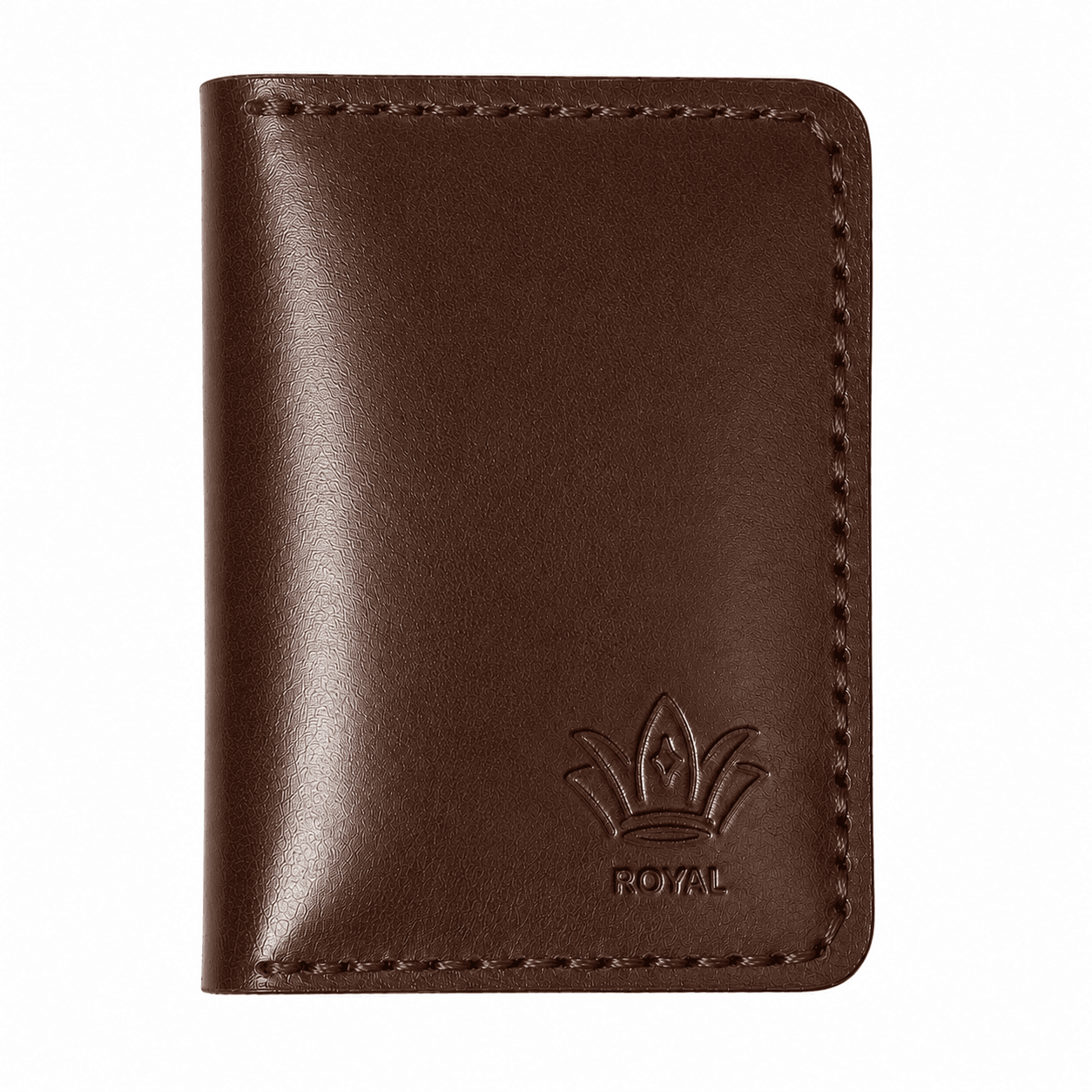
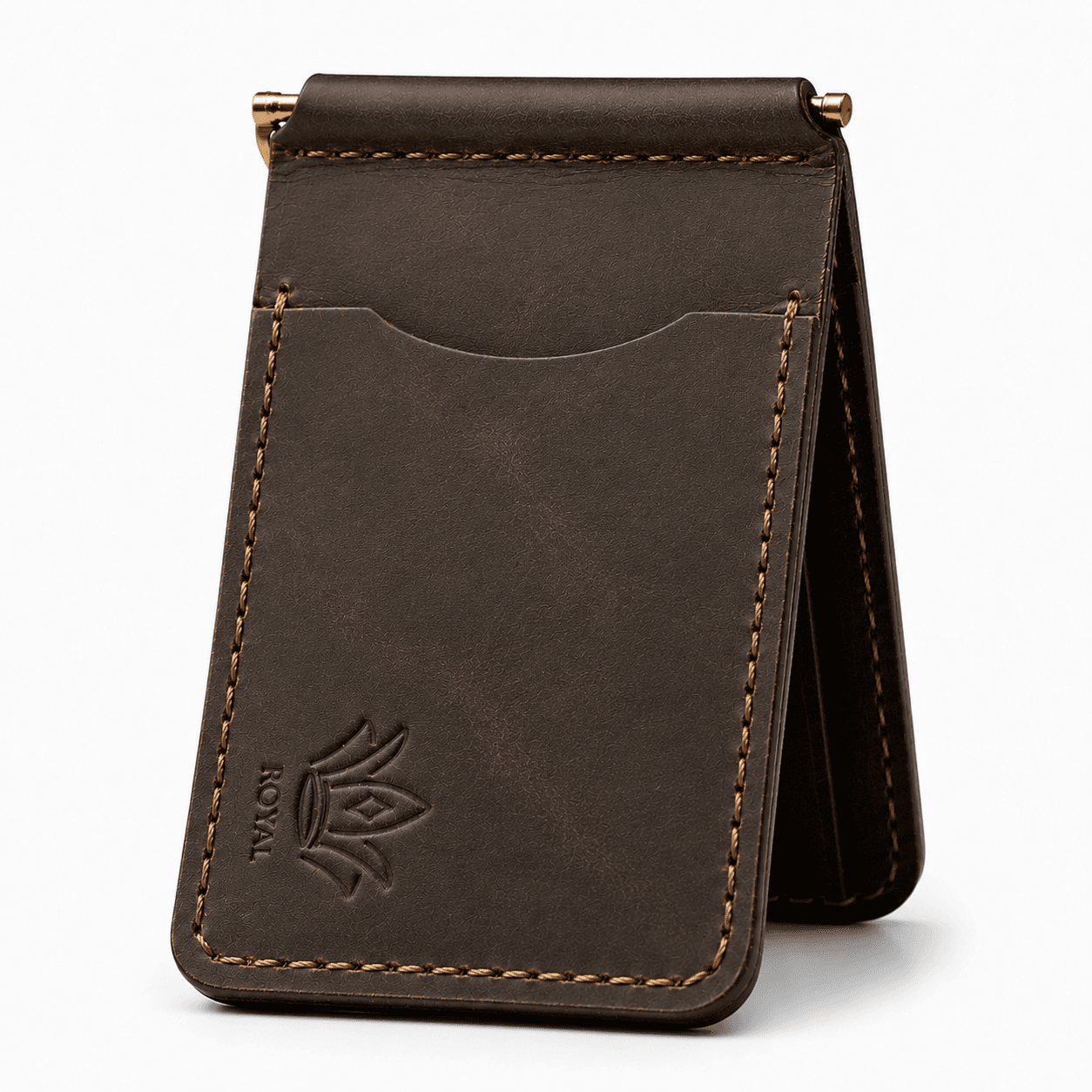
Every piece we make is saddle-stitched by hand in full-grain Tuscan-tanned leather — wallets, card holders, cash clips, straps and keychains, with no machine-sewn line in the catalogue.
Wallets · Card holders · Browse everything
Frequently asked questions
What is a saddle stitch?
A hand-sewing technique using one length of thread and two needles, which pass through each hole from opposite sides so the two ends cross inside the leather. It produces two independent interlocking passes of thread along the seam rather than the single chained lockstitch a machine makes.
Why is saddle stitching stronger than machine stitching?
Because it has no chain to unravel. A machine lockstitch knots two threads at every hole, so a single break releases the neighbouring stitches and the seam opens. A saddle stitch keeps its two passes independent, so a broken thread weakens one hole and leaves the rest of the seam intact.
How can I tell if a wallet is saddle stitched?
Check that the seam looks the same on both faces, that the stitches sit at a consistent slant rather than square to the seam, and that they are regular without being machine-identical. Heavier waxed thread is a further clue.
How long does saddle stitching take?
Roughly forty minutes of hand work for a wallet, against under a minute for the equivalent machine seam. That labour is essentially the whole price difference between hand-stitched and machine-sewn pieces.
Is saddle stitching worth the extra cost?
On full-grain leather, yes, on cost per year of use: a machine-sewn wallet in corrected leather typically lasts about two years while a saddle-stitched full-grain one lasts a decade. On cheap leather it is not worth it, because the stitching will outlive the material it holds together.
Can a saddle stitch be repaired?
Yes, and more easily than a machine seam, because the surrounding stitches have not loosened. A maker can re-stitch the damaged section through the existing holes without unpicking the rest of the seam.
Shop the story