GUIDES
Full-Grain vs Top-Grain vs Genuine Leather
The leather industry's naming is close to adversarial. "Genuine leather" sounds like a guarantee and is in fact one of the lowest grades sold. "Top-grain" sounds like the top and isn't. The result is that most people pay for a word rather than a material.
Here's the whole hierarchy, explained by a workshop that buys, cuts and stitches these hides — including how to identify each one with nothing but your hands and a bit of light.
Quick comparison
| Grade | What it actually is | Lifespan | Develops patina? | Typical use |
|---|---|---|---|---|
| Full-grain | The complete outer layer of the hide, surface intact | Decades | Yes — the whole point | Heirloom wallets, saddlery, boots |
| Top-grain | Outer layer with the surface sanded off and refinished | 5–10 years | Barely | Most "designer" leather goods |
| Genuine leather | The lower splits left after the good layer is removed | 1–3 years | No — it cracks | Fast-fashion belts, cheap wallets |
| Bonded leather | Scraps shredded and glued to a backing, embossed | 1–2 years | No — it peels | Budget furniture, bargain bins |
Full-grain: the whole hide, nothing removed
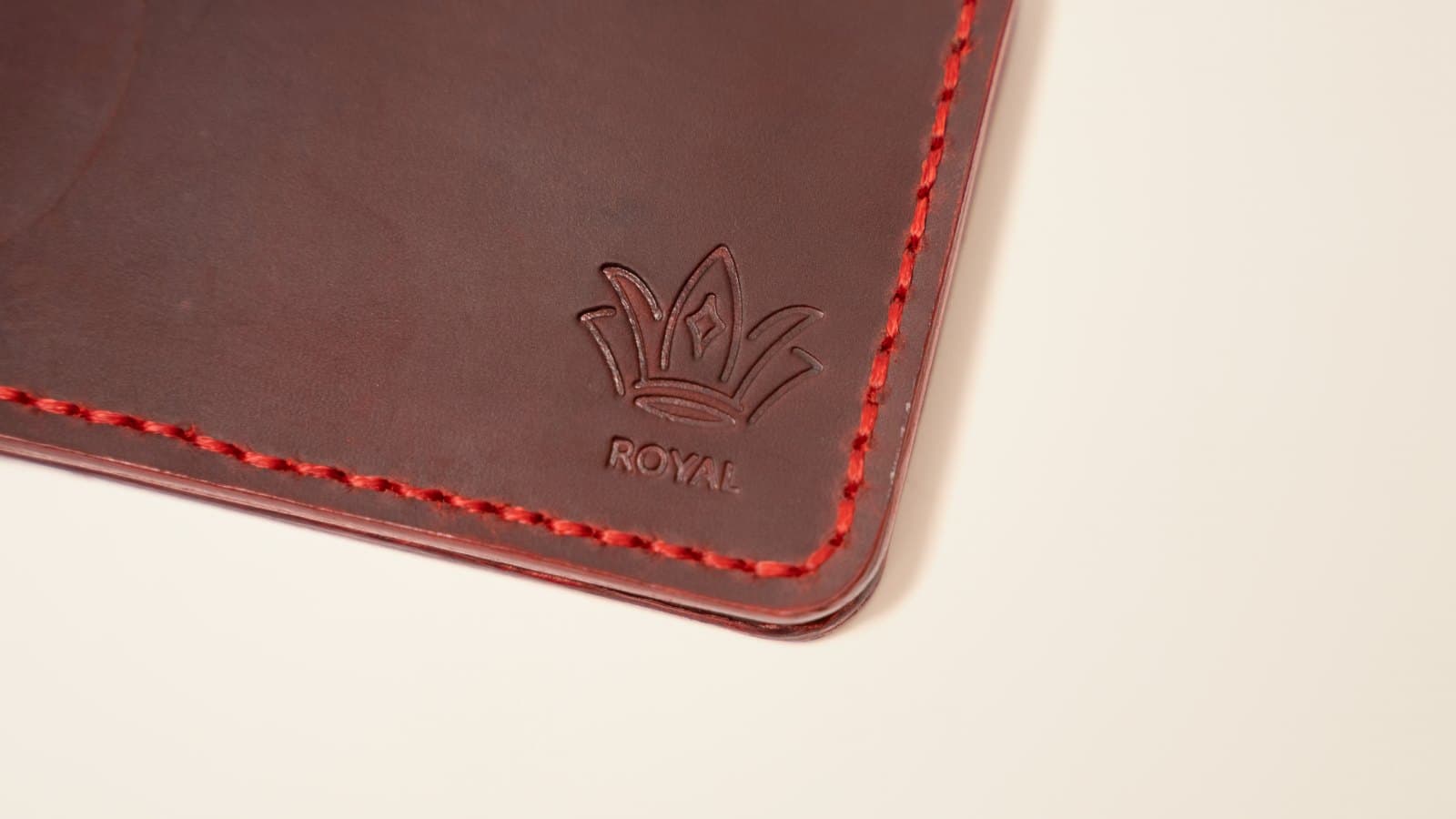
A hide has layers. The outermost is the tightest, densest fibre — it spent the animal's life as the surface, so it's the strongest part of the material. Full-grain is that layer left completely intact: nothing sanded, nothing buffed, nothing sprayed on to hide anything.
That means you can see the hide's actual history — grain variation, the occasional healed scar, small differences in tone across a panel. Manufacturers sand those away because uniform product photographs sell more easily. What sanding also removes is the strongest fibre in the material.
Why it ages the way it does: the intact grain absorbs oils from your hands and the air, and the surface burnishes where it's handled. That's patina — the darkened fold line, the glossy corners, the deepening colour. It's oxidation and friction doing something attractive rather than something destructive, and it only happens on full-grain. Every other grade is trying to prevent change; full-grain is designed to reward it.
The trade-off, honestly: full-grain costs more per square foot, it isn't uniform, and it shows scratches early on (most of which buff out or settle into the patina). If you want a wallet that looks identical in year five, buy top-grain — or metal. If you want one that looks better, this is the only grade that does it.
Top-grain: the outer layer, corrected
Top-grain starts as the same outer layer, then the surface is sanded to remove imperfections and a finish is applied — often a pigment or plastic coating with an embossed, artificial grain pattern.
The result is uniform, stain-resistant, easy to photograph, and used by a large share of the luxury market. It's genuinely decent material. But sanding removes the densest fibre, and the applied finish sits on top of the leather rather than being part of it. Over years, that coating is what cracks and flakes — the leather beneath may be fine while the surface fails.
Expect five to ten years of good service, and very little patina — the coating prevents the absorption that patina depends on.
"Genuine leather": the marketing trap
Here is the sentence worth remembering: "genuine leather" means only that some cow was involved.
After the outer layer is split away for full-grain and top-grain products, the lower layers remain. Those splits are what "genuine leather" typically is — looser, weaker fibre, usually heavily finished, painted or embossed with a fake grain to look like something it isn't.
It cracks. It peels. On a wallet, the failure usually shows up within one to three years at the fold and the card-slot edges, because that's where the material flexes and the finish gives up. The tell is that peeling reveals a different colour underneath — the finish separating from the leather.
A stamp reading "GENUINE LEATHER" on the outside of a product is, more often than not, a warning label. Real full-grain goods rarely advertise the fact on their face; they let the material do it.
Bonded leather: not really leather
Leather scraps and dust, shredded, mixed with polyurethane or latex, spread on a fibre backing and embossed with a grain pattern. It's to leather roughly what particleboard is to timber. It delaminates and flakes, often within a year of regular use. It's legal to call it leather in many markets; it shouldn't be bought expecting leather behaviour.
How to identify each grade in your hands
You can do this in a shop, in about thirty seconds:
- Look at the surface under angled light. Full-grain shows irregular, non-repeating pores and small natural variations. A pattern that repeats is embossed — corrected or fake.
- Look at a cut edge. Full-grain shows a dense fibrous cross-section that's the same material through and through. Bonded shows a visible backing layer. Coated leathers show a distinct thin surface film.
- Press and release. Full-grain wrinkles gently and springs back with the grain moving as one piece. Coated leather creases sharply, like a film being folded.
- Smell it. Full-grain smells rich and slightly sweet. Heavy plastic or chemical smell means finish, not hide.
- Read the words carefully. "Made with genuine leather", "leather-backed", "bonded" — all signals. "Full-grain" and "vegetable-tanned" are claims specific enough to be checkable.
- Look for uniformity. Perfect, blemish-free consistency across a large panel almost always means the surface was corrected.
A note on tanning, which matters as much as grade
Grade tells you which part of the hide. Tanning tells you how it was preserved, and it shapes how the leather behaves.
Vegetable tanning uses tannins from bark and plant matter, takes weeks, and produces firm leather that patinas dramatically — the traditional choice for wallets and saddlery. Chrome tanning uses chromium salts, takes a day or two, and produces softer, more colour-stable leather — most of the world's leather, and the right choice for garments and bags where drape matters.
Neither is a scam. But a wallet is a piece that benefits from firmness and patina, which is why our front pocket wallets and card holders are cut from full-grain hide.
Cost, over the life of the object
The grade argument is really an arithmetic argument:
| Genuine leather wallet | Full-grain wallet | |
|---|---|---|
| Purchase | ~$15 | $26.99 |
| Realistic life | ~2 years | 10+ years |
| Ten-year cost | ~$75 (5 replacements) | $26.99 |
| Condition at year 5 | Discarded | Better than new |
The expensive option is the cheap one. That's the whole case, and it's laid out with more scepticism in are handmade leather wallets worth it.
Royal and full-grain
We only cut full-grain. Not as a marketing position — because the pieces we make are small, handled constantly and have nowhere for weak material to hide. A wallet gets touched more times a day than almost anything else you own; there's no honest way to build one for a decade out of a corrected split.
Every piece is cut and finished by hand, with a 1-year warranty and 30-day returns.
Wallets · Card holders · Watch straps · Everything
Choosing between styles rather than grades? Front pocket vs bifold vs card holder and our minimalist wallet guide both cover that. Already own full-grain? Five minutes twice a year is all it asks: how to condition a leather wallet.
Frequently asked questions
Is genuine leather real leather?
Technically yes, but it's one of the lowest grades — typically the lower splits left after the strong outer layer is removed for better products. It is not a quality guarantee, and a prominent "genuine leather" stamp usually indicates a low-grade product.
Which is better, full-grain or top-grain?
Full-grain is stronger and the only grade that develops real patina, because its surface fibre is intact. Top-grain is sanded and refinished — more uniform and stain-resistant, but shorter-lived and largely patina-free.
How can I tell if leather is full-grain?
Look for irregular, non-repeating pores and natural variation, a dense uniform cross-section at cut edges, gentle wrinkling that springs back, and a rich rather than chemical smell. Perfectly uniform surfaces almost always mean the grain was corrected.
Does full-grain leather scratch easily?
It marks more visibly than coated leather early on, and most light scratches buff out with a fingertip's warmth or disappear into the patina after conditioning. Deeper marks stay — on full-grain, that's generally considered part of the appeal.
Is vegetable-tanned better than chrome-tanned?
Neither is universally better. Vegetable tanning gives firmer leather with dramatic patina, ideal for wallets and belts; chrome tanning gives softer, more colour-stable leather better suited to garments and bags.
What is bonded leather?
Shredded leather scrap bound with polyurethane or latex onto a backing and embossed with a grain pattern. It typically delaminates within a year or two of regular use and behaves nothing like solid leather.
Shop the story